
With just 2 Champions league trophies over the last 10 years and only 13% of matchday revenue made in the 2018/19 season. Why do Premier League clubs still offer the most expensive tickets in Europe’s top three leagues? And is it time for the multibillion pounds industry to rethink their prices in order to not price out fans?
The experience of going to watch your favourite team at the stadium for the first time as a child is one of the best memories any football fan has, regardless of the result. It’s a tradition that many parents pass on to their children.
However, sharp ticket prices increases, especially in the last 15 years has meant that many fans are having to spend much more than they can afford to watch their team.
With some having stopped going to stadiums already, many more could follow suit due the financial struggles as a result of unemployment during the coronavirus crisis.
The Premier League as we know it today was formed in 1992.
At the time, the cheapest ticket you could buy to watch a team live was around £8, whilst the most expensive was £30. If we use the Bank of England’s simple Inflation calculator, we would find that in 2019 prices, the cheapest ticket should have been £16.50 whilst the most expensive should have been £62.50.
Yet in the 2018-2019 season, which was the last time fans were allowed into stadiums for a full season, every Premier League team had the cheapest ticket listed for £25 or more except for Liverpool (£9) and Wolves (£22). Whilst six teams had prices above £62.50 for the most expensive tickets, with Arsenal charging the most expensive single ticket at the time (£97).
Arsenal Independent Supporters Trust’s committee chair, Drew Gray says that he believes football fans are being priced out but doesn’t expect it to change because stadiums are still full.
“I started going to Arsenal in the late 70s and it cost about £5-8 to stand on the North Bank. My seat is in about the same place as where I used to stand and it costs between £35-55 per match (depending on the opposition). However Arsenal do offer a decent deal via the ST (if you get one) and League Cup (Carabao) games are very cheap (they are not included in the ST cost).
“Bottom line is that for most ‘big’ games (and quite a few smaller ones) the ground is mostly full and is often sold out even when not everyone with a ticket attends. So there’s no pressure on the club to reduce prices.”

Problems with the current system
So you may be wondering, how can it be sold out when not everyone attends? The answer is of course, season ticket holders.
According to the Premier League, 75% of all seats ‘sold’ in the 2018-2019 season were sold to season ticket holders, who pay a one off fee every season to have seats reserved to all home league games (and some cup games) but don’t have to attend if they don’t want to.
Due to this high percentage and the other 6% of seating that goes to away fans, only 19% of tickets remain for the rest of the fans.
Therefore, it is clear that the combination of low availability of regular matchday tickets (caused by high numbers of season ticket allocations) as well as the high demand from fans to attend games along with many clubs’ greed has driven prices up higher than they should be, and at the expense of loyal fans.
Buying a season ticket is no better solution.
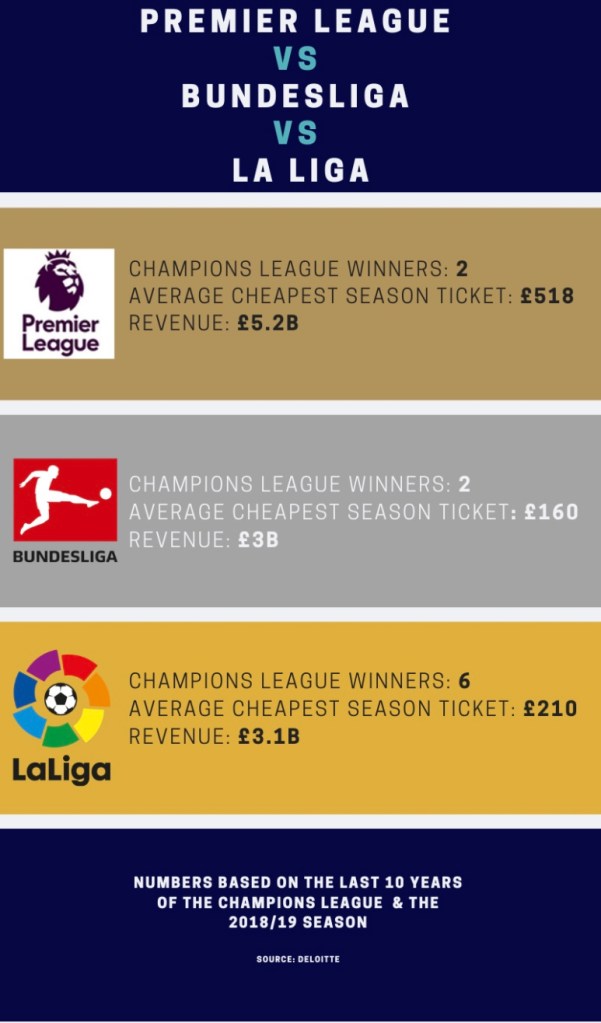
You will most likely have to join a waiting list which could take years and once you actually get offered one, the cheapest on average will cost you £518 whilst the most expensive on average is £924.
The Bundesliga & La Liga
If you compare these prices with the German Bundesliga or Spain’s La Liga, it becomes very apparent that Premier League fans are paying more than they should.
On average, the Bundesliga’s cheapest season ticket in the 2018/19 season was £160 whilst the most expensive was £635. Spain’s La Liga offered fans an average cheapest season ticket for £210 and £810 for the most expensive.
But why do the Premier League charge so much for fans to watch games live when their two main competitors don’t? What’s the justification?
Some people may argue that the Premier League is the best league in the world. Whether that’s true or not depends on your definition of ‘best’.
If we look at the best club competition in Europe, the champions league, we see that from the 2010/11 season to 2019/20 both English and German teams have only won it twice whilst Spanish teams won it six times. Yet Premier League clubs on average charged three times as much as German clubs for the cheapest season tickets and over twice as much as Spanish clubs.
Others may argue that football clubs are not only here to entertain us, they’re a business and should be charging as much as they think fans will pay in order to make a profit.
It is certainly true that clubs have to make a profit otherwise they will not be sustainable.
However, according to Deloitte, in the 2018-2019 season, Premier League clubs had a revenue of £5.2 Billion but only £776 million came from matchday sales (13%). On the other hand, Broadcasting had a revenue of £3.1 Billion and Sponsorships made £1.4 Billion.
Based on those numbers alone, the Premier League can reduce prices to the level offered in the Bundesliga and La Liga on season/matchday tickets and they wouldn’t lose much of their revenue.
How COVID has changed the game
In March 2020 and in the middle of the 2019/20 season, the coronavirus postponed all Premier League games. When matches resumed in June, fans were not allowed to enter stadiums due to tight social distancing measures imposed.
Initially around ⅓ of remaining matches were broadcasted for free. But by the start of the 2020-2021 season, Premier League clubs along with TV broadcasters introduced Pay Per Views at £14.95 per game. A decision that was so unpopular amongst fans that it was quickly scrapped by the Premier League.
Daniel Lawless from West Ham Fan TV didn’t like the idea and it was something that made him really angry.
“Fans already pay so much for their BT, SKY boxes, Amazon and TV license. I think it’s a lot more easy to swallow if it was something like £5, they were even charging £14.95 even for the Carabao cup games.
“What they’re doing is taking advantage of people’s loyalty to their football club because they know how passionate football fans are to watch their team and they try to take advantage of that because what are fans going to do? Not watch their team play? I’m glad that people were donating the money to charities. And all of this goes back to the greed of Premier League football.”
What should be done?
As we can clearly see, there is no doubt that Premier League fans are being priced out.
The prices they’re having to pay are way too much in comparison to the other two top european leagues. Especially when the revenue made from matches is very small when compared with TV Broadcast deals and Sponsorships. Premier League clubs are simply charging these prices because as of now, stadiums are still being filled and tickets are still being bought, with an average attendance of 38,000.
Let’s assume that somehow Premier League clubs were open to recommendations on how to improve affordability and access to tickets, what would be the dream scenario for many fans?
The first thing is to obviously reduce the prices on the cheapest matchday and season tickets by at least 25%.
Secondly, a cap on the most expensive tickets should also be introduced based on a team’s league position. A club should only be allowed to charge high prices if they qualify to a European tournament. This will also increase competition and add an extra incentive to finish high in the league.
And lastly, all Premier League teams should aim to reduce the number of season ticket holders in stadiums by around 25% in order to make more tickets available for other members and general sales. This will give a variety of fans the opportunity to watch the games live.
Based on history and how Premier League clubs have been over the past few years, I doubt that there will be any reductions made to either matchday or season tickets at the majority of clubs. Clubs will continue to charge as much as they can as long as fans carry on buying.
Therefore, the only option fans have is to boycott games or at least stage some sort of walk out to send a message to owners. This will obviously only apply to certain clubs that have very expensive tickets. It will also be very difficult for a lot of fans as the majority are too emotionally invested into their clubs and have been going to stadiums all their lives, so that habit will be the biggest obstacle to making change.
 Zakaria Taibi